Chores for kids work best when they are framed as contributing to the family, not as a job that earns pay. Research links regular chores to stronger self-competence and thinking skills, while experiments with toddlers suggest that rewarding helping can weaken the urge to help. The counterintuitive move is less “do this and get paid” and more “in this family, we all pitch in.”
Key Takeaways
- In a U.S. study of 9,971 children, kindergartners who did chores more often reported higher social, academic, and life-satisfaction competence by third grade.
- Very young children help on their own; in one experiment, 20-month-olds who got a material reward for helping later helped less than toddlers who were praised or not rewarded.
- Age-appropriate chores for kids grow from putting away toys and setting the table at 5 to cooking a simple supervised meal by 11 or 12, according to the American Academy of Pediatrics.
Picture a Tuesday evening. Dinner is late, the dishwasher is full, and you are clearing the table yourself because asking your kids feels like starting a negotiation you do not have the energy to win. Faster to do it alone, you tell yourself.
That shortcut is understandable, and almost every parent takes it sometimes. But the research on household work suggests the slower path pays off. This guide covers what chores actually build, why the way you frame them matters as much as the tasks themselves, and what kids can realistically handle at each age.
Why Do Chores for Kids Matter So Much?
Regular chores for kids provide repeated, real-world practice at being competent and useful, and that experience seems to stick. The largest study on the question comes from the Journal of Developmental and Behavioral Pediatrics, where researchers analyzed 9,971 children in a national U.S. cohort that entered kindergarten in 2010 to 2011.
Parents reported how often their kindergartners did chores. By third grade, children who had done chores more often rated themselves higher in social, academic, and life-satisfaction competence, even after accounting for sex, family income, and parent education. Children who rarely did chores had modestly higher odds of scoring in the bottom fifth on prosocial behavior, peer relationships, and life satisfaction. Doing chores with any frequency was also linked to better third-grade math scores.
A second line of research looks at thinking skills. In a 2022 study in the Australian Occupational Therapy Journal, parents of 207 children ages 5 to 13 reported on chores and executive function. Kids who did more self-care chores (such as making their own meal) and family-care chores (such as making a meal for someone else) showed better working memory and inhibition, the skills behind remembering steps and resisting distractions.
Both studies are correlational. Families where kids do chores may differ in other ways, and the executive function study relied on parent reports at a single point in time. Still, the direction is consistent: chores for kids look less like a burden and more like practice for life.
Contribution vs. Payment: What Motivation Research Says
How you frame chores shapes whether kids want to help. Toddlers arrive eager. A classic experiment published in Developmental Psychology found that 20-month-olds who received a small material reward for helping an adult later helped less than toddlers who received praise or nothing. The researchers called this an overjustification effect: once helping becomes a transaction, the reward becomes the reason.
That fits a broader pattern. A 1999 meta-analysis of 128 experiments in Psychological Bulletin found that expected tangible rewards tended to reduce people’s intrinsic motivation for an activity, while positive verbal feedback tended to increase it. In self-determination theory, the model behind that work, motivation lasts when people feel autonomy, competence, and connection, which is exactly what helping the family can offer.
Cultural research adds a useful contrast. Psychologists Andrew Coppens and Lucía Alcalá described two family patterns among U.S. university students. European American students tended to recall allowances given in exchange for assigned chores. Mexican-heritage students often recalled pocket money given as a gift, not tied to chores, and described family work as something they joined to contribute. The authors connect this to a tradition of “learning by observing and pitching in,” where kids are included in real work and take initiative.
None of this means money is bad. It means chores and money usually work better as separate conversations, with allowance treated as a tool for learning about money rather than as a wage.

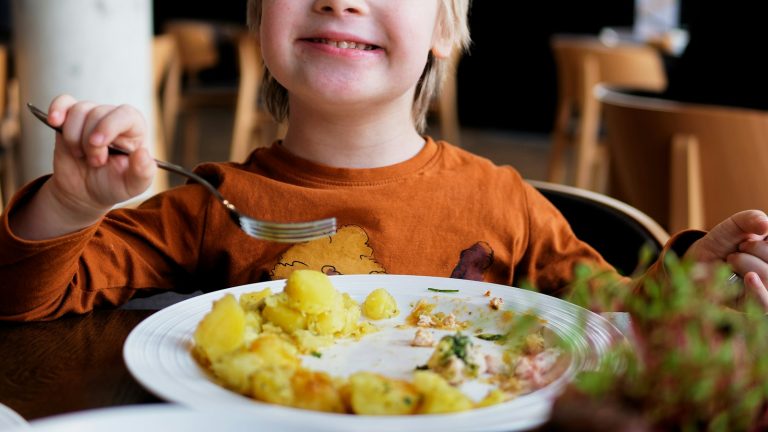
Young children want to be part of real work; including them, even when it is slower, protects that instinct. Photo: Vitaly Gariev / Unsplash.
Age-Appropriate Chores for Kids: A Practical List
Most children can start simple household tasks in the preschool years and take on real cooking and cleaning by the end of elementary school. The American Academy of Pediatrics offers age-based examples, summarized below. Each band builds on the one before it.
| Age | Self-care chores | Family-care chores |
|---|---|---|
| 2 to 4 | Put toys in a bin, carry own cup to the counter | Hand you clean spoons to put away, help feed a pet with you |
| 5 to 7 | Make bed, put away toys | Set and clear the table, sweep, empty wastebaskets, water plants |
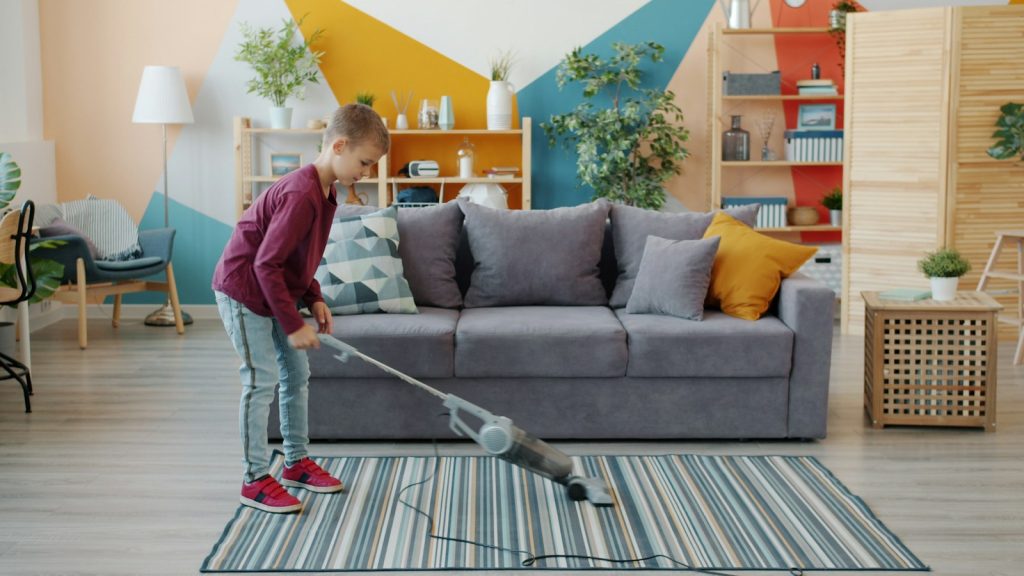
| 8 to 10 | Put away own laundry, make simple snacks | Vacuum, help make dinner, walk the dog, put away groceries |
| 11 to 12 | Do own laundry, change bed linens | Clean kitchen or bathroom, unload dishwasher, cook a simple meal with supervision, watch a sibling while an adult is home |
Treat the list as a menu, not a test. Temperament, development, and family logistics all matter, and the AAP recommends introducing one new task at a time.
How Do You Get Kids Helping Without Constant Nagging?
The most reliable approach is to make chores for kids predictable, shared, and small enough to finish. Nagging usually signals that the expectation is unclear or the routine is missing, not that the child is lazy.
- Attach chores to existing routines. “After dinner, plates go to the counter” works better than a vague “help more.”
- Work alongside young kids first. Folding towels together teaches the steps and keeps it social.
- Accept imperfect results. Redoing a child’s work in front of them teaches that their effort does not count.
- Praise the effort and the initiative. Specific, honest feedback (“You noticed the trash was full and took it out”) reinforces contribution. Our guide on how to praise your child explains why process praise works.
- Use a brief family meeting. Revisit who does what every few weeks so the plan grows with your kids.
Language matters too. “Can you help me?” frames the work as yours. “The table needs setting; what part will you take?” frames it as shared. That small shift supports the kind of autonomy described in our guide to autonomy-supportive parenting.
Self-Care Chores vs. Family-Care Chores
A good mix of chores for kids includes both kinds, but family-care chores carry a special message: other people depend on you. Self-care tasks, like packing a lunch or putting away laundry, build independence. Family-care tasks, like setting the table for everyone or feeding the dog, build a sense of belonging and responsibility to others.
In the executive function study above, both types predicted better working memory and inhibition. A balanced chore plan includes some of each, so kids learn to take care of themselves and to show up for the household.
This is also where well-meaning parents slip into doing too much. Clearing every obstacle from a child’s path can feel loving, but it quietly removes chances to build competence. Our piece on snowplow parenting explores that pattern in more depth.

Cooking for the family is a family-care chore that also exercises planning and working memory. Photo: Vitaly Gariev / Unsplash.
What If Your Child Resists Chores?
Resistance is normal, especially when chores for kids are new or feel unfair. Start by checking whether the task is clear, sized right, and part of a routine. Many conflicts shrink once a child knows exactly what “clean your room” means.
When a child still refuses, calm and predictable consequences tend to work better than lectures. The AAP suggests that losing a privilege, rather than badgering, is a reasonable response. Kids also watch how adults divide household work. If one parent carries most of it, children notice; our article on the default parent looks at how that imbalance plays out.
If your child consistently struggles to follow through at home and has similar trouble at school, the AAP recommends talking with your pediatrician. Difficulties with attention or organization can make multi-step chores genuinely harder, and support helps.
Frequently Asked Questions About Chores for Kids
What age should kids start doing chores?
Most children can start simple tasks as preschoolers, such as putting toys away or carrying their cup to the counter. Toddlers often want to help before parents ask. Starting early, with small tasks done together, makes chores feel like a normal part of family life.
Should I pay my kids for chores?
Research on motivation suggests that paying for everyday family chores can shift a child’s reason for helping from contribution to reward. Many families keep basic chores unpaid and, if they wish, offer separate paid jobs for bigger extra tasks. Allowance can still be a useful money-learning tool on its own terms.
How many chores for kids are too many?
There is no research-based number. A useful test is whether chores fit alongside school, sleep, and play without constant stress. The AAP cautions against overloading kids and suggests adjusting expectations to the individual child.
Do chore charts work?
They can, especially for younger kids who benefit from a visual reminder. Charts work best as a shared plan the family reviews together, rather than as a scoreboard. Keep them simple and update them as kids grow.
Small Hands, Real Contributions
The point of chores for kids is not a spotless house. It is the steady message that your child is a capable, needed member of the family. Research ties that experience to greater self-competence and stronger thinking skills, and motivation science suggests it lasts longest when helping is not a transaction.
Start small, work alongside them, keep money as a separate conversation, and let responsibilities grow as your kids do. The dishes will take longer for a while. What you are building takes longer, too.
This article is for general education and is not a substitute for advice from a licensed pediatrician or child development professional.
Written by
Elena Rostova
Elena Rostova is the byline used for articles published by Relationship 99. It is a pen name, not a licensed clinician. Articles here are built from published research in relationship science - including work by John Gottman, Arthur Aron and researchers in attachment theory - with the studies named in the text so readers can check them. How we research, source and review our articles is set out in full at relationship-99.com/editorial-standards. Relationship 99 is not a therapy service, and nothing here replaces advice from a qualified professional.