Nobody hands you the real warning about marriage after baby. They tell you about the sleep, the diapers, the way your heart cracks open the first time the baby grips your finger. What they leave out is quieter and stranger: that somewhere in the first year, you may look across the kitchen at the person you chose on purpose and feel a flat, confusing distance you have no name for. You are not falling out of love. You are standing at the edge of a well-documented cliff, and almost no one told you it was there.
This is one of the most predictable transitions in all of relationship science, and also one of the least talked about at the baby shower. Understanding what is actually happening — and what isn’t — changes how you read those first depleted months. The distance is not a verdict on your marriage. It is a phase with a shape, a cause, and a way through.
What really happens to your marriage after baby
Drs. John and Julie Gottman, who tracked couples through the transition to parenthood for decades, found that roughly two-thirds of couples report a meaningful drop in relationship satisfaction in the first three years after a baby arrives. Sixty-seven percent. That number is so high it should be printed on the side of every crib, and yet most couples meet the slump privately, each one assuming they are the failure in a sea of glowing families.
Here is the part that reframes everything: the same research found that about a third of couples held steady or even grew closer. The decline is common, but it is not a law of physics. Which means the goal of the first year is not to magically avoid the dip — it is to stop the dip from hardening into a permanent shape.
The cliff is sudden, not slow
We tend to imagine relationships eroding gradually, like a coastline. The most rigorous study on this says otherwise. Brian Doss, Galena Rhoades, Scott Stanley and Howard Markman followed 218 couples across the first eight years of marriage, and watched what happened when a first child arrived. Compared to each couple’s own pre-baby trajectory, parents showed a sudden deterioration after birth — in observed behavior and in how they rated the relationship themselves. The drop was small-to-medium in size, it hit mothers and fathers in similar amounts, and, crucially, it tended to persist for years rather than bounce back on its own.
That word — sudden — matters enormously. It explains why the cliff blindsides people. A couple spends nine months bracing for a hurricane of love and exhaustion, and instead gets ambushed weeks later by a low, grey resentment that seems to come from nowhere. It came from somewhere. It came from a step change in the conditions of their daily life, happening faster than either partner could update their expectations.

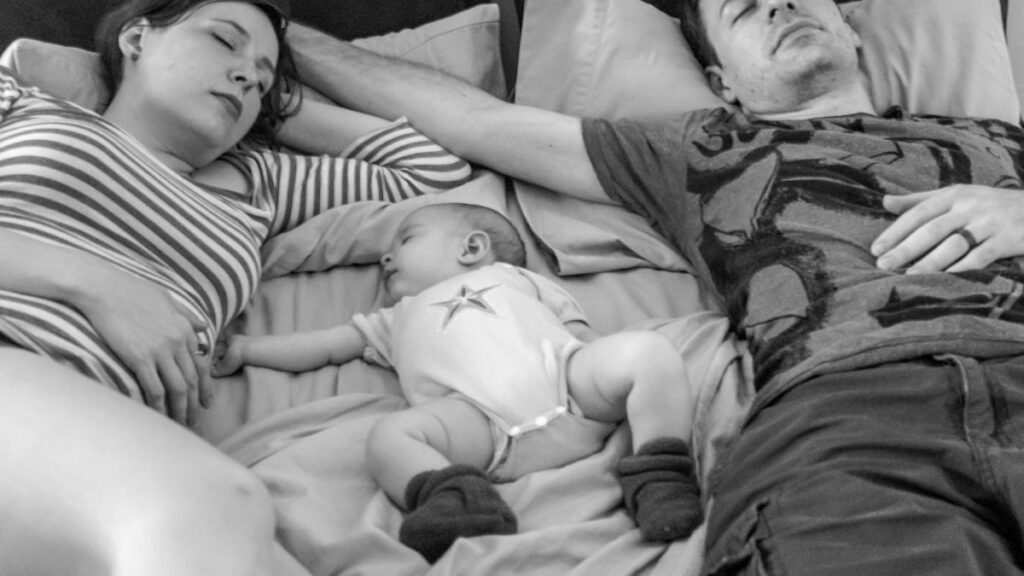
The early months run on a sleep debt that quietly reshapes how two people treat each other. Photo: Jude Infantini / Unsplash.
Why love is rarely the thing that breaks
If you had asked me to guess what cracks first, I would have said affection. I would have been wrong. In most struggling new-parent couples, the love is intact. What collapses is the infrastructure that carried the love — the unhurried conversations, the inside jokes, the small daily turns toward each other.
The Gottmans call these turns bids for connection: a partner says “look at this bird” or “I had the weirdest dream,” and the other either turns toward them, away, or against them. Healthy relationships run on a steady stream of tiny bids being answered. Now picture that stream during a newborn’s witching hour, on four hours of broken sleep, with a bottle to warm and a work email blinking. The bid gets made and lands in empty air. Not out of cruelty — out of sheer depletion. Do that a few hundred times and partners quietly learn to stop reaching, because reaching has started to feel like one more thing that goes unmet.
So the marriage doesn’t usually end with a fight. It thins out, one missed bid at a time, until two people who still love each other are essentially co-managing a small human as polite, tired colleagues. Naming that mechanism is oddly freeing. It means the repair isn’t some grand reckoning. It is rebuilding the habit of turning toward each other in three-minute increments.
The fairness finding that surprised researchers
Here is where the science gets genuinely useful, and a little counterintuitive. When researchers dug into why some new-parent couples slide and others don’t, the strongest predictor was not how the housework and childcare were actually divided. It was whether each partner experienced the division as fair.
Studies on the transition to parenthood found that perceived fairness — not the raw hours logged — was what tracked with depression, conflict, and marital dissatisfaction. A couple can split the night feeds fifty-fifty and still be miserable if one of them feels the arrangement was imposed rather than agreed. Another couple can have a lopsided split that both genuinely chose, and stay close. The corrosive ingredient isn’t imbalance. It’s the quiet sense that the imbalance is unjust and unspoken.
This connects directly to the slow grind of the mental load — the invisible project-management of a household that so often lands on one partner after a baby. The fix isn’t a perfectly equal chore chart. It’s making the invisible visible: saying out loud who is tracking the pediatrician appointments, the diaper inventory, the daycare forms, and renegotiating it openly instead of letting one person silently drown while the other genuinely has no idea.

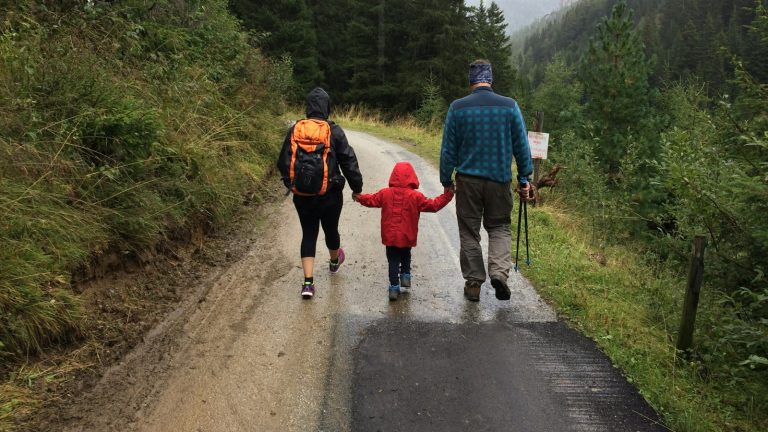
Couples who narrate the change out loud tend to weather it better than couples who go silent. Photo: Sandeep Kashyap / Unsplash.
What the couples who stay close actually do
The third of couples who hold steady aren’t superhuman, and they aren’t sleeping more than anyone else. From the research and from watching real families move through this, a few patterns stand out — and none of them require a date night at a restaurant you can’t get a sitter for.
They expected the cliff. The single most protective move is knowing the dip is coming. Couples who treat the early slump as a normal, temporary feature of the terrain stop reading it as evidence that they chose the wrong person. The catastrophizing — “we’re broken” — does more damage than the tiredness itself.
They keep micro-bids alive. Not weekends away. A six-second kiss. A text that isn’t logistics. Asking “how are you, actually?” while passing the baby off. The couples who recover protect a thin but unbroken thread of connection through the worst of it, so there’s something to rebuild from when sleep returns.
They renegotiate out loud. Instead of keeping a silent ledger of who did more, they say the uncomfortable thing early: “I’m underwater and I need you to own bath time and bedtime without me asking.” Resentment grows in silence; it shrinks in daylight. Learning to do this without it detonating is its own skill — the same one behind any decent repair after a fight.
They protect a sliver of the couple identity. The relationship existed before the baby and has to be allowed to keep existing alongside it. That can be fifteen minutes after the baby’s down where you talk about literally anything other than the baby. It sounds small. It is the whole ballgame, because it is the foundation of the trust that everything else rests on.
If you’re in the dip right now
Be careful with the story you tell yourself in this season. Exhaustion is a master storyteller, and at 3 a.m. it will happily narrate your marriage as a mistake. It isn’t. A drop in satisfaction after a baby is one of the most ordinary experiences two loving people can have, and the data says most of those people are still very much in a relationship worth fighting for. The cliff is real. It is also, for most couples, survivable — especially the ones who see it for what it is.
If you want to keep reading on the terrain underneath all of this, the Family Life & Parenting and Marriage sections go deeper on the specific moves.
A note: the early postpartum months can also surface something heavier than ordinary strain. If you or your partner are experiencing persistent low mood, hopelessness, intrusive thoughts, or difficulty bonding with the baby, that may be postpartum depression or anxiety — which is common, treatable, and not a character flaw. Please reach out to your doctor, midwife, or a mental health professional. This article is general information, not a substitute for individual medical or psychological care.
Written by
Elena Rostova
Elena Rostova is the byline used for articles published by Relationship 99. It is a pen name, not a licensed clinician. Articles here are built from published research in relationship science - including work by John Gottman, Arthur Aron and researchers in attachment theory - with the studies named in the text so readers can check them. How we research, source and review our articles is set out in full at relationship-99.com/editorial-standards. Relationship 99 is not a therapy service, and nothing here replaces advice from a qualified professional.