How to repair after a fight is the single most important relationship skill almost no one is taught. We obsess over how to avoid arguments, how to communicate so we never clash, how to find someone so compatible that conflict simply melts away. But after watching how couples actually behave, the researchers who have studied this longest landed on a less comfortable truth: the fight is rarely the thing that breaks a relationship. What breaks it is the silence, the score-keeping, and the cold half-hour that comes after the fight.
The good news in that is enormous. You do not have to become a couple that never argues to become a couple that lasts. You only have to get good at one underrated skill — learning how to repair after a fight — and the window for it is shorter and earlier than you think.
The fight is not the problem. The aftermath is.
Decades of observational research by Drs. John and Julie Gottman, who have studied thousands of couples in a lab setting, found that conflict itself does not predict whether a couple stays together. Happy, lasting couples argue. Some of them argue loudly. What separated the couples who thrived from the ones who drifted apart was their ability to make and accept what the Gottmans call repair attempts — any gesture, large or small, that tries to stop the spiral and rebuild connection. You can read their own summary of the science in the Gottman Institute’s work on repair.
In their words, repair attempts predict long-term success more reliably than conflict style or even compatibility. The couples who last are not the ones who never rupture. They are the ones who are good at mending. So if you have ever finished an argument feeling secretly defeated — convinced that the fact you fight at all means something is wrong — let that go. The fighting is normal. The question that actually matters is what the two of you do in the ten minutes that follow.

The cold half-hour after a fight is where relationships are quietly won or lost. Photo: Etienne Boulanger / Unsplash.
Why you can’t repair after a fight while you’re flooded
Here is the part almost no listicle mentions, and it changes everything about timing.
When an argument escalates, your body can tip into a state the Gottmans call flooding, or diffuse physiological arousal. Your heart rate climbs, adrenaline releases, blood pressure rises — the full fight-or-flight response. Their research points to a rough threshold: once your heart rate passes about 100 beats per minute, you physically cannot take in what your partner is saying, no matter how hard you try. Your nervous system has decided this is a threat, and it has stopped listening.
This is why so many “let’s just talk it out right now” attempts go nowhere or make things worse. You are trying to negotiate with someone whose brain has temporarily gone offline — and so has yours. Any attempt to repair after a fight in that state is built on sand.
The fix is not willpower. It is chemistry and time. The stress neurochemicals that flood your system have to clear, and that takes most people roughly 20 minutes — but only if you genuinely distract yourself during the break rather than rehearsing your next argument in your head. So the real sequence is not “talk immediately.” It is: notice you are flooded, take a real break, come back, then repair.
What a repair attempt actually sounds like
Repair attempts are often small and unglamorous. A repair attempt is not a grand apology speech. It can be a hand on a shoulder, a bit of shared humor, or a single sentence that signals “I am still on your team.” Because they are small, they are also easy to miss — which is the other half of the skill. The couples who do well are not just good at offering repairs; they are good at noticing and accepting them, even when they are still annoyed.

A genuine repair attempt is usually one quiet sentence, not a speech. Photo: Priscilla Du Preez / Unsplash.
Here are the kinds of phrases that work, grouped by what they are actually doing under the hood. The goal when you repair after a fight is not eloquence; it is sincerity. Steal these, but say them in your own words — a repair only lands if it sounds like you.
To pause without abandoning
- “I want to get this right, and I’m too worked up to think straight. Can we take twenty minutes and come back to it?”
- “I’m not walking away from you. I just need to cool down so I can actually hear you.”
The distinction matters enormously. A break is not the silent treatment. The silent treatment is punishment with no return date. A repair break names the return.
To take some responsibility
- “My reaction was bigger than the moment. I’m sorry for the way I said that.”
- “You’re not wrong about that part. Let me own it.”
You do not have to concede the whole argument to concede a piece of it. One honest “you have a point there” can do more to lower the temperature than ten minutes of defending yourself. When the rupture runs deeper than a single argument, deliberate trust-building exercises for couples can rebuild the foundation over time.
To re-establish that you are on the same side
- “I think we both want the same thing here, we just got there sideways.”
- “I hate fighting with you. Can we start this part over?”
To check what your partner actually needs
- “Do you want me to help solve this, or do you just want me to understand how it felt?”
That last one quietly prevents a huge share of repeat fights, because a startling number of arguments are really one person offering solutions when the other person wanted to feel heard. Getting better at active listening prevents more fights than any clever comeback ever will. And if communication is the recurring sticking point for you two, our guide on building trust in a relationship pairs well with this one.
What not to say in the first ten minutes
Just as useful as the right scripts is knowing which moves quietly sabotage your effort to repair after a fight. In the fragile window right after a rupture, avoid:
- The fake apology with a tail. “I’m sorry, but if you hadn’t…” is not a repair. The word “but” deletes everything before it.
- Reopening the case. Bringing fresh evidence — “and another thing” — tells your partner the fight is not actually over, so their guard goes right back up.
- Keeping score. “Well, last month you did the exact same thing” turns one repairable moment into a referendum on the entire relationship.
- Demanding the repair be accepted instantly. Sometimes you offer a hand and your partner is still too flooded to take it. Offer it again in a few minutes rather than treating the first miss as a rejection.
How to repair after a fight: a simple 4-step sequence
You will not recall a ten-point framework while your pulse is pounding. So here is the whole thing compressed to four moves, in order.
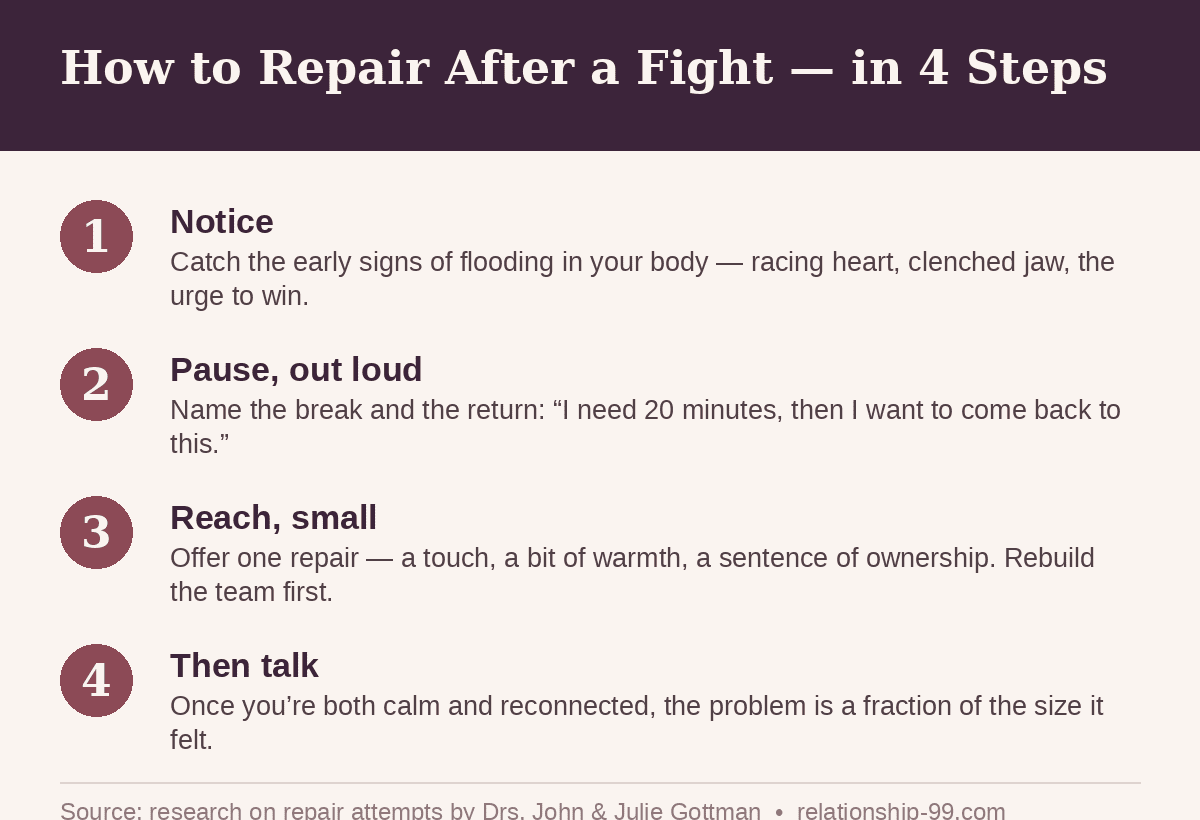
- Notice. Catch the early signs of flooding in your own body — clenched jaw, racing heart, the urge to “win.” That awareness alone buys you a second of choice.
- Pause, out loud. Name the break and name the return. “I need twenty minutes, and then I want to come back to this.” Then actually do something calming, not stewing.
- Reach, small. Come back with one repair — a touch, a bit of warmth, a single sentence of ownership. You are not solving the issue yet. You are re-establishing the team.
- Then, and only then, talk. Once you are both regulated and reconnected, the actual problem is usually a fraction of the size it felt like an hour ago.
Notice what is missing from that list: winning. Learning to repair after a fight is not about who was right. It is the deliberate, slightly humbling decision that the relationship matters more than the scoreboard.
This works whether you’re dating, married, or co-parenting
One reason we love this skill is that it does not expire when a relationship changes shape. A couple three months into dating can use it to learn how they fight before the patterns harden. A couple fifteen years into marriage can use it to break a cold-war habit that has quietly calcified. Even separated co-parents — who still have to navigate disagreements for years — can use a stripped-down version to keep conflict from poisoning the handoffs that affect their kids. The instinct to repair after a fight travels with you from one stage of love to the next.

Reaching back — again and again — is the habit that keeps love intact. Photo: Priscilla Du Preez / Unsplash.
You will not get the timing right every time. Almost no one does. There will be nights the repair comes an hour too late, or not until morning. That is fine. “Repair early and repair often” is the goal, not the grade. What matters is that reaching back becomes the thing you reliably do — your shared reflex after a rupture, rather than the rare exception.
Because in the end, a strong relationship is not the absence of fights. It is two people who have quietly agreed, again and again, to find their way back to each other after one. Master how to repair after a fight, and you have mastered the part that actually keeps love intact.
If conflict in your relationship feels constant, contemptuous, or frightening rather than the ordinary friction described here, that is worth taking seriously. Consider reaching out to a qualified couples therapist who can work with your specific situation.
Frequently asked questions about how to repair after a fight
How do you repair after a fight with your partner?
Reconnect within the first few minutes: take responsibility for your part, offer a genuine apology, listen without defending, and make a small repair gesture. It is the repair, not avoiding conflict, that protects the relationship.
What is a repair attempt?
A repair attempt is any gesture — a joke, an apology, reaching out, softening your tone — that de-escalates tension during or after conflict.
Should you go to bed angry?
It is less about the clock and more about reconnecting before resentment sets in. A brief, sincere repair matters more than resolving everything that night.
Written by
Elena Rostova
Elena Rostova is the byline used for articles published by Relationship 99. It is a pen name, not a licensed clinician. Articles here are built from published research in relationship science - including work by John Gottman, Arthur Aron and researchers in attachment theory - with the studies named in the text so readers can check them. How we research, source and review our articles is set out in full at relationship-99.com/editorial-standards. Relationship 99 is not a therapy service, and nothing here replaces advice from a qualified professional.