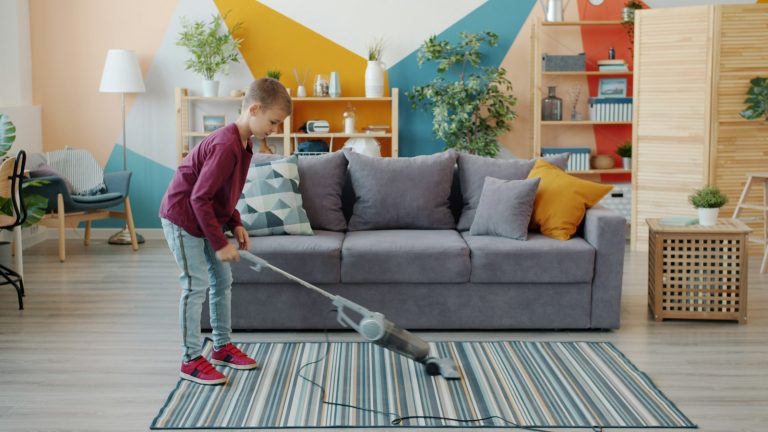
Co-regulation is the process of lending a child your own calm nervous system so they can settle before they are able to settle themselves. Young children cannot self-regulate on command — the brain regions responsible are still years from mature. That is why “calm down” fails: an upset child first has to borrow your steadiness through your tone, face, and body, and only later internalizes it as self-regulation.
Think about the last full-body meltdown in the cereal aisle. You told your four-year-old to settle down, and it poured gasoline on the fire. It was not defiance. You were asking a brain that had temporarily flipped its lid to do something it physically could not do yet, alone. What that child needed was not an instruction but a calmer nervous system to sync up with — yours.
What Co-Regulation Actually Means
Co-regulation is the warm, back-and-forth support that helps a child manage feelings and behavior in the moment. In a widely cited practice brief for the U.S. Administration for Children and Families, researchers define it as the “supportive process between caring adults and children” that builds self-regulation over time (Rosanbalm & Murray, 2017). Regulation, in other words, is not a solo skill children are born with. It is caught before it is taught.
This matters because the popular picture of discipline assumes children can control themselves and simply choose not to. The research flips that assumption: the calm has to arrive from the outside first. A child steadies by leaning on a regulated adult thousands of times until the capacity slowly becomes their own.

A child borrows calm before they can generate it. Photo: Xavier Mouton Photographie / Unsplash.
Why “Calm Down” Backfires
When a child is flooded, the thinking part of their brain is effectively offline and the alarm system is running the show. Telling them to calm down is a verbal command aimed at the exact brain region that has stopped listening. Worse, an irritated “calm down” signals that you, too, are rattled, which raises the child’s alarm rather than lowering it.
The approach works through the opposite channel. Children read safety from your nonverbals long before your words — a lowered voice, an unhurried body, a soft face. When your nervous system says “we are safe,” theirs can begin to follow. That is why getting quiet and getting close usually outperforms getting loud.
The Three Ingredients of Co-Regulation
The ACF research frames effective co-regulation as three things working together (Co-Regulation Practice Brief). First, a warm, responsive relationship, so the child feels safe leaning on you. Second, a structured environment with predictable routines and clear limits, which lowers the number of meltdowns before they start. Third, active coaching of skills — naming feelings, modeling calm, and practicing strategies during easy moments so they are available during hard ones.
Notice that two of the three ingredients happen when nothing is going wrong. Much of this work is preventive: the calm relationship and the reliable routine do quiet labor long before any storm. Related research on early childhood makes the same point about building these skills gradually rather than demanding them (Murray et al., self-regulation brief).

Predictable warmth prevents more storms than any consequence. Photo: Liane Metzler / Unsplash.
Co-Regulation Isn’t Permissiveness
Parents often worry that staying calm and connected during a meltdown rewards bad behavior. It does not. The goal is to steady the child’s body, not to approve of what they did. You can hold a firm limit — “I won’t let you hit” — while still offering a calm presence that helps them come back down.
In fact, limits and warmth are partners, not opposites. A child learns far more from a boundary delivered calmly than from one shouted in the heat of the moment. If the discipline side is where you struggle, our take on making kids apologize pairs well with this, and our look at how we praise kids shows why the emotional climate you set matters as much as the rules.
A Simple Script for the Next Meltdown
In the moment, keep it short. Get down to the child’s level so you are not looming. Lower and slow your voice on purpose, even if you have to fake the calm at first. Name what you see without arguing about it: “You are really mad the tower fell.” Then offer your steady presence rather than a lecture: “I’m right here. We’ll figure it out together.”
Save any teaching, consequences, or problem-solving for later, once the storm has passed and the thinking brain is back online. Trying to reason with a flooded child is like trying to teach someone to swim while they are drowning.
None of this requires you to be a perfectly serene parent. It only requires you to be a slightly calmer nervous system than the one melting down in front of you, often enough for the pattern to stick.
What Co-Regulation Looks Like at Different Ages
With toddlers, co-regulation is almost entirely physical and present-tense: getting low, a steady voice, a hug, simple words. With school-age children, you can add language — naming the feeling, walking through what happened afterward, rehearsing a better plan. With teenagers, it looks like staying non-reactive when they are not, resisting the urge to match their intensity, and being a reliably calm base they can return to.
The through-line at every age is the same: your regulation comes first. A teen who slams a door still borrows your steadiness, even if they would never admit it. Over years, this is how the outside calm becomes an inside skill.
When You’re the One Who’s Dysregulated
Here is the uncomfortable part: you cannot lend a calm you do not have. If your child’s meltdown reliably triggers your own, co-regulation starts with regulating yourself — a breath, a pause, sometimes stepping back for a moment before you respond. This is not weakness; it is the whole mechanism. A useful trick is to pick one physical cue in advance — unclenching your jaw, dropping your shoulders, or exhaling slowly to a count of six — and use it as your own reset button the instant you feel your temper climb, so your body leads your mind back to steady.
It also helps to lower your baseline stress so you have calm to spare. Overscheduled, overstimulated homes make this harder for everyone, which is one reason unstructured downtime matters; our piece on independent play explores that. And beware the modern trap of half-present parenting described in technoference, since a distracted adult is a harder one to sync up with.
Frequently Asked Questions About Co-Regulation
At what age can a child self-regulate on their own?
There is no clean finish line. Self-regulation develops gradually across childhood and adolescence and is not fully mature until the mid-twenties. Children need less support as they grow, but even adults borrow calm from each other during hard moments.
Is co-regulation the same as gentle parenting?
They overlap but are not identical. Co-regulation is a specific, research-backed mechanism for how self-control develops, while “gentle parenting” is a broader style. You can practice it and still hold firm, clear limits.
Does co-regulation spoil children?
No. Responding to a child’s distress with calm support builds the very brain circuits they will later use to soothe themselves. What undermines outcomes is inconsistency and harshness, not warmth paired with structure.
What if I already yell a lot?
Repair matters more than perfection. Reconnecting after you lose your temper — a genuine “I got too loud, that’s on me” — teaches your child that relationships can bend without breaking, which is itself a lesson in regulation.
A note: this article is general parenting education, not medical or psychological advice. If your child’s dysregulation is extreme, frequent, or involves harm to themselves or others, please consult your pediatrician or a licensed child mental-health professional.
Written by
Elena Rostova
Elena Rostova is the byline used for articles published by Relationship 99. It is a pen name, not a licensed clinician. Articles here are built from published research in relationship science - including work by John Gottman, Arthur Aron and researchers in attachment theory - with the studies named in the text so readers can check them. How we research, source and review our articles is set out in full at relationship-99.com/editorial-standards. Relationship 99 is not a therapy service, and nothing here replaces advice from a qualified professional.