Independent play and childhood anxiety are connected in a way most American parents have never been told: the sharp rise in kids’ anxiety over the past fifty years tracks almost exactly with the collapse in the amount of time children spend doing anything without an adult watching. In 2023, psychologist Peter Gray and colleagues laid out that case in The Journal of Pediatrics, and the implication is uncomfortable. We have been treating a freedom problem as a feelings problem.
The short answer: independent play — unsupervised, self-directed activity where children make and live with their own decisions — appears to build the sense of control that protects against anxiety and depression. Gray, David Lancy, and David Bjorklund argued that the decades-long decline in this kind of activity is a primary driver of the decline in young people’s mental health. The intervention is not more emotional processing. It is more unsupervised competence.
This is not a nostalgia piece about how kids used to roam until the streetlights came on. It is about a specific, measurable ingredient that has been removed from American childhood, and what happens when you put a little of it back.
What does the research on independent play and childhood anxiety actually say?
Gray’s team assembled evidence from several directions. Time-use studies show that children’s free, unsupervised time has fallen steadily since the 1950s while time in adult-directed activity — school, homework, organized sports, structured enrichment — has climbed. Over the same period, measures of anxiety and depression in young people rose sharply, and, notably, so did scores on measures of external locus of control: the belief that your life is determined by forces outside you rather than by your own choices.
That last piece is the mechanistic link. Locus of control is one of the more robust predictors of anxiety in the psychological literature. Independent activity is one of the few things known to shift it, because it is where children get repeated, unfaked evidence that their decisions produce outcomes. A supervised activity, however enriching, cannot deliver that evidence — an adult is always available to fix it.
The authors were careful about causality; this is correlational evidence assembled into an argument, not a randomized trial. But the convergence is hard to ignore, and it points somewhere unusual.

Unsupervised time is where children learn that their choices produce outcomes. Photo: Annie Spratt / Unsplash.
Why supervised activities do not substitute for independent play
Parents often hear this research and reach for the wrong fix — more park time, more playdates, more sports. Those are good things and they are not the same thing. Gray’s distinction turns on one variable: whether an adult is available to intervene.
In independent play, four things happen that cannot happen under supervision:
- Children set the rules and enforce them. A backyard game with no referee requires negotiating fairness, tolerating a bad call, and keeping the game going anyway. That is conflict resolution practiced under real stakes.
- They calibrate their own risk. Kids climbing a tree without an adult stop at the height that frightens them. That self-titration is how the nervous system learns that fear is information, not an emergency — the same principle underlying exposure therapy.
- They are genuinely responsible. If nobody else is going to solve it, the child solves it. If an adult might, the child waits.
- Boredom gets to do its work. Unstructured time with nothing scheduled is where children generate their own goals, which is the origin of intrinsic motivation.
An enrichment class delivers none of these, no matter how good it is. This is where well-meant involvement tips into something else, a pattern we covered in our piece on snowplow parenting.
How much independence is appropriate for my child’s age?
There is no single answer, and American norms have drifted far from both historical practice and the rest of the world. A rough, conservative ladder that many families use:
- Ages 4–6: Playing in another room or a fenced yard for stretches without a parent hovering. Pouring their own cereal. Choosing their own clothes and wearing the mismatched result.
- Ages 6–8: Walking to a neighbor’s house, playing in the front yard, ordering their own food at a counter, running a small errand within sight.
- Ages 8–10: Walking or biking to a nearby friend’s house or park. Staying home alone for short, defined periods. Managing a chunk of homework without an adult in the room.
- Ages 10–13: Independent travel on familiar routes, unsupervised time with friends in public places, real responsibility for something a family depends on.
Two caveats matter. First, this ladder is about your specific child and your specific neighborhood, not an average. Second, one of the more useful pieces of context for anxious parents: US crime data shows violent crime rates against children are dramatically lower than in the 1990s. The perceived risk has risen while the actual risk has fallen — a gap driven largely by news coverage and social media rather than by anything happening on your street.

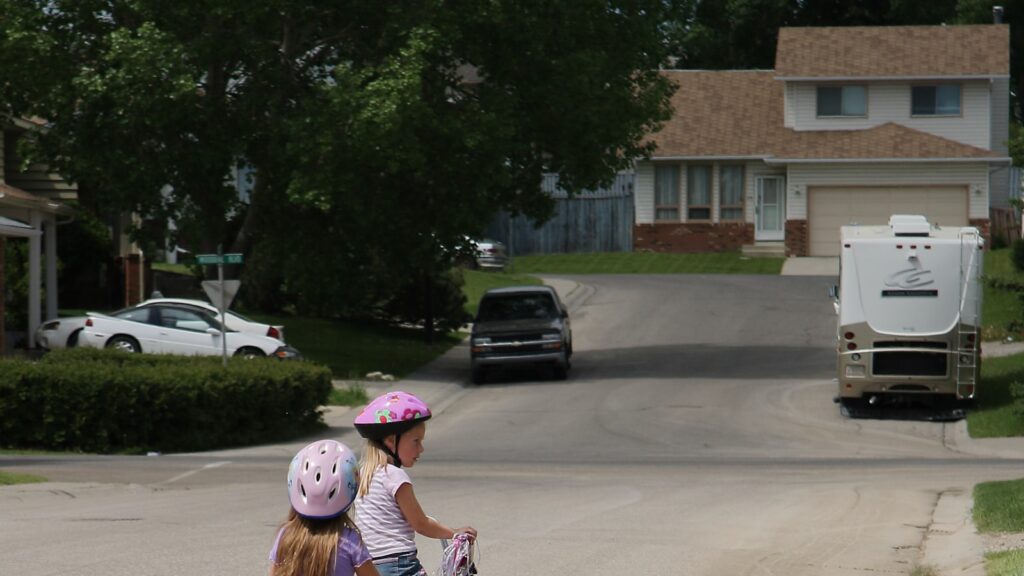
Children calibrate their own risk when no adult is standing by. Photo: Annie Spratt / Unsplash.
What gets in the way — and it is usually not the child
Most parents who read this research agree with it and then do not change anything. The obstacles are real and worth naming.
Your own anxiety is the binding constraint. Granting independence means tolerating a period of not knowing where your child is. Many parents discover the intervention is mostly on themselves. That is uncomfortable but not a reason to skip it; the discomfort is the point, for both of you.
Social judgment is a real cost. American parents face genuine scrutiny for letting kids do things that were unremarkable in 1985. Several states have passed “reasonable childhood independence” laws in recent years partly in response to this. Knowing your state’s law is worth ten minutes.
Nobody else’s kids are outside. Independent play needs other children available. This is the hardest problem and the one worth solving socially — talk to two neighbors, agree on a window, and the whole thing becomes possible. One family cannot recreate a neighborhood alone.
The schedule is full. Independent time is unproductive by design, which makes it the first thing cut. If it is not protected on the calendar, it does not happen.
What this does not mean
It does not mean supervision is bad, that anxious kids should be pushed into situations that overwhelm them, or that emotional support is misguided. Warmth and co-regulation matter enormously, and we have written about both — see co-regulation with kids and emotion coaching.
The argument is about balance. American parenting has become very good at the emotional-support half of the job and unusually poor at the competence-building half. A child who is beautifully validated and never trusted with anything real is missing an ingredient that validation cannot supply. More at our family life and parenting archive.
Frequently asked questions
Is my anxious child ready for more independence, or will it make things worse?
Anxious children generally benefit from graded independence rather than none, but the steps should be small and chosen with them. This mirrors exposure-based treatment, which is the front-line evidence-based approach for childhood anxiety. If your child’s anxiety is significantly impairing daily life, work with a child psychologist rather than doing this alone.
What if my neighborhood genuinely is not safe?
Independence does not require a suburban street. It can be built inside an apartment, a courtyard, a relative’s home, or a supervised-perimeter park where an adult is present but deliberately not intervening. What matters is that the child is making real decisions without rescue, not the square footage.
At what age can a child legally stay home alone in the US?
Only a few states set a specific minimum age — Illinois and Maryland are the most commonly cited — and most leave it to parental judgment under general neglect statutes. Several states have passed laws explicitly protecting reasonable independent activity. Check your own state, since guidance varies widely.
How do I start if my child has never had unsupervised time?
Start smaller than feels meaningful. One errand at the end of a familiar aisle. Twenty minutes in the yard while you stay inside and do not watch from the window. Then debrief by asking what they figured out, not whether they were scared. The goal is accumulating evidence of their own competence.
This article is general information and not medical or psychological advice. If your child is experiencing significant anxiety, depression, or distress, please consult a pediatrician or licensed child mental health professional. In the United States, the 988 Suicide and Crisis Lifeline is available by call or text.
Written by
Elena Rostova
Elena Rostova is the byline used for articles published by Relationship 99. It is a pen name, not a licensed clinician. Articles here are built from published research in relationship science - including work by John Gottman, Arthur Aron and researchers in attachment theory - with the studies named in the text so readers can check them. How we research, source and review our articles is set out in full at relationship-99.com/editorial-standards. Relationship 99 is not a therapy service, and nothing here replaces advice from a qualified professional.