Ask any parent of two why siblings are so different and you’ll get a shrug and a joke: same house, same rules, same gene pool, completely different humans. The athlete and the reader. The one who negotiates and the one who slams doors. It’s treated as a charming mystery.
The short answer: Siblings differ far more than shared genes and a shared home would predict, and behavioral genetics has a name for the reason — the nonshared environment. Part of that difference isn’t accidental at all: children actively differentiate themselves from a sibling, a process researchers call sibling deidentification. Growing up in the same family does not mean growing up in the same environment.
Once you see the mechanism, a lot of ordinary family friction stops looking like personality and starts looking like strategy.
Why siblings are so different: the finding that surprised the researchers
In 1987, behavioral geneticists Robert Plomin and Denise Daniels published a paper with a title that reads like an exasperated parent: “Why are children in the same family so different from one another?” Their answer reshaped developmental psychology. Across personality, psychopathology, and cognitive traits, siblings raised together turned out to be far less alike than a shared-family model predicted. The environmental influences that mattered most were the ones siblings did not share.
This was genuinely counterintuitive. The assumption had been that family environment works like weather — everyone under the same roof gets the same climate. What the data suggested instead is that each child occupies a different microclimate: different birth order position, different parental treatment, different friends, different teachers, different accidents of timing. Plomin has continued to argue in more recent work that much of this nonshared influence is effectively idiosyncratic and unsystematic — closer to chance than to any tidy variable a parent could control.
Which is, if you sit with it, partly reassuring. The differences between your children are not a report card on your parenting.
Sibling deidentification: when being different is the point
The other half of the story is more active. In the 1970s, psychologist Frances Fuchs Schachter documented a pattern she called sibling deidentification: siblings — especially the first pair, and especially same-sex pairs — describe themselves as explicitly unlike each other, often in mirror-image terms. One is “the responsible one,” so the other becomes “the fun one.” One is “the smart one,” so the other becomes “the athlete.”
Schachter’s interpretation, drawing on Alfred Adler, was that deidentification serves a function: it defuses direct rivalry. If two children compete on the same dimension, one of them has to lose daily. If they occupy different dimensions, both can be someone. It’s a peace treaty negotiated by children who lack the vocabulary to negotiate.
Later work on sibling differentiation in adolescence found the same dynamic operating alongside its opposite — younger siblings both imitate and deliberately diverge from older ones, depending on the domain and the relationship. The tug between “be like them” and “be anything but them” is not a contradiction; it’s the normal machinery of working out who you are while someone very similar is standing right there.

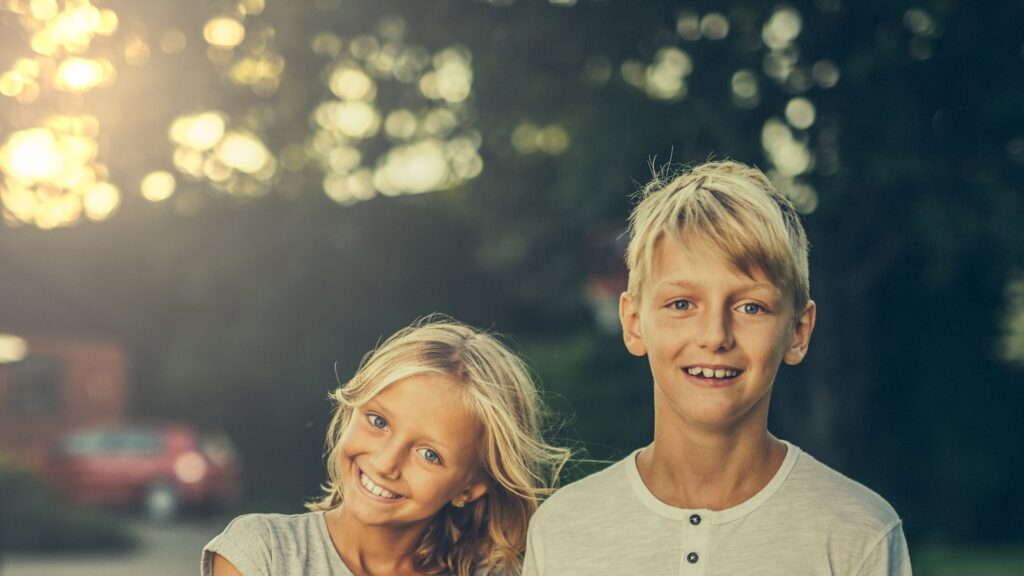
Difference between siblings is often a strategy, not an accident. Photo: Janko Ferlič / Unsplash.
How families accidentally lock the roles in place
Deidentification starts with the children. It gets cemented by everyone else. The mechanism is almost always well-intentioned language:
- The comparative compliment. “She’s our reader” is a compliment to one child and a closed door to the other. Nobody hears the door close.
- The efficient shorthand. Families run on labels because labels save time — “ask your brother, he’s the organized one.” Repeated a few hundred times, shorthand becomes identity.
- The retired trait. Once a role is claimed, the other child often stops trying in that domain entirely, which produces exactly the evidence that confirms the label. The 8-year-old who “isn’t musical” doesn’t practice, and then genuinely isn’t musical.
- The relative frame. “You’re doing so much better than your sister did at this age” is meant as praise and lands as a scoreboard.
This is adjacent to but distinct from outright parental favoritism. A parent can be scrupulously even-handed in affection and still hand out roles that shape a child’s sense of what is available to them.
What to do differently, concretely
Describe behavior, not identity. “You worked on that for forty minutes without stopping” tells a child something they can repeat. “You’re the persistent one” tells them something their sibling now can’t be. The general principle — that process praise outperforms trait praise — shows up throughout the research on how to praise kids, and it matters twice as much when there’s a sibling listening.
Deliberately cross the lines. Sign the “non-athlete” up for the low-stakes rec league. Take the “non-reader” to the library alone. The point isn’t to produce a new talent; it’s to demonstrate that the domain was never sealed.
Protect one-on-one time, and make it unremarkable. Twenty minutes with one child, without the other present, is where a kid can try on a version of themselves that isn’t defined in opposition to anyone. It doesn’t need to be an event. A drive to the store counts.
Retire the labels out loud. Older children can hear this directly: “I’ve called you the responsible one for years and I think that’s been unfair to both of you.” Naming a family script is often enough to loosen it.

One-on-one time gives a child room to be someone who isn’t defined against a sibling. Photo: Annie Spratt / Unsplash.
What this means when siblings grow up
Roles assigned at seven have a long half-life. Adult siblings frequently snap back into childhood positions within twenty minutes of a holiday dinner — the caretaker starts organizing, the wild one starts provoking, the peacekeeper starts smoothing. The house is different, the script isn’t.
The useful reframe for adults is that these roles were solutions to a problem that no longer exists. Nobody is competing for a finite supply of parental attention anymore. The rivalry that deidentification was invented to prevent has expired; the division of territory it produced has not. Adult siblings who manage to renegotiate usually do it by trespassing deliberately — the “irresponsible” one handling a parent’s medical logistics, the “serious” one being the funny one at the wedding.
Worth remembering too: what looks like a stark difference from inside the family often looks like a modest one from outside it. Families amplify contrast. Two siblings described at home as opposites are frequently, to everyone else, obviously related.
Why siblings are so different: where to read more
Why siblings are so different is a question behavioural genetics has studied for decades, and the nonshared environment findings are still being refined. The American Psychological Association publishes plain-language summaries of that research if you want the primary literature.
Frequently asked questions
Is it normal for siblings to have completely different personalities?
Yes, and it’s more the rule than the exception. Behavioral genetics research consistently finds that siblings raised in the same household are much less similar in personality than shared genes and a shared environment would predict. Most of the environmental influence that shapes them is nonshared — unique to each child.
What is sibling deidentification?
It’s the process by which siblings define themselves as unlike each other, often in opposing pairs — the studious one and the athletic one, the responsible one and the free spirit. Frances Fuchs Schachter documented the pattern in the 1970s and argued it functions to reduce direct rivalry by giving each child a separate domain.
Does birth order determine personality?
Not in the way popular accounts suggest. Large modern studies have found birth order effects on personality to be very small or negligible. What birth order does reliably change is a child’s position — who arrived first, who watched whom — and that position feeds the deidentification process rather than stamping in a fixed personality.
Should I stop calling my kids “the smart one” and “the funny one”?
Yes. Even affectionate labels tend to allocate territory, and the child who didn’t get a domain often quietly stops competing in it. Describing specific behavior you observed — rather than assigning a permanent trait — keeps every dimension open to both children.
This article is general information and not a substitute for professional assessment. If a sibling relationship involves persistent aggression, fear, or distress, a child or family therapist can help.
More on raising siblings and the everyday mechanics of family life in our Family Life & Parenting archive.
Written by
Elena Rostova
Elena Rostova is the byline used for articles published by Relationship 99. It is a pen name, not a licensed clinician. Articles here are built from published research in relationship science - including work by John Gottman, Arthur Aron and researchers in attachment theory - with the studies named in the text so readers can check them. How we research, source and review our articles is set out in full at relationship-99.com/editorial-standards. Relationship 99 is not a therapy service, and nothing here replaces advice from a qualified professional.