The family dinner benefits you have read about are not fake, but they are almost certainly misattributed. Every few years a new round of headlines promises that eating together lowers teen drug use, raises grades, and protects mental health. Parents hear this as an instruction about logistics — get everyone at the table, five nights a week, no exceptions — and then feel like they are failing when work, practice, and traffic make that impossible.
Here is the honest version. Family dinner benefits show up reliably in correlational research, but when researchers control rigorously for everything else going on in a family, most of the effects shrink dramatically. What survives is not the meal. It is the sustained, unstructured, adult-led conversation that a shared meal happens to be very good at protecting — and that can be protected other ways.
What does the research on family dinner benefits actually show?
The strongest test came from sociologists Kelly Musick and Ann Meier, who published an analysis in the Journal of Marriage and Family in 2012 using three waves of the National Longitudinal Study of Adolescent Health — nearly 18,000 teenagers. In the simple cross-sectional picture, family dinners looked powerful: teens who ate with their parents more often had better mental health, less substance use, less delinquency.
Then they applied fixed-effects models, which compare the same teenager to themselves over time and therefore strip out stable family characteristics. Most of the associations weakened substantially. Only the link between family dinners and depressive symptoms held up with any strength, and the researchers found little evidence that the effects persisted into young adulthood.
A 2014 systematic review in the Journal of Youth and Adolescence reached a similar conclusion, noting that the family-meal literature is dominated by cross-sectional designs and that causal claims have outrun the evidence.
The interpretation is not that family dinners are worthless. It is that frequent family dinners are a marker of families with more time, more stability, and more contact — and much of the benefit belongs to those underlying conditions rather than to the meal.

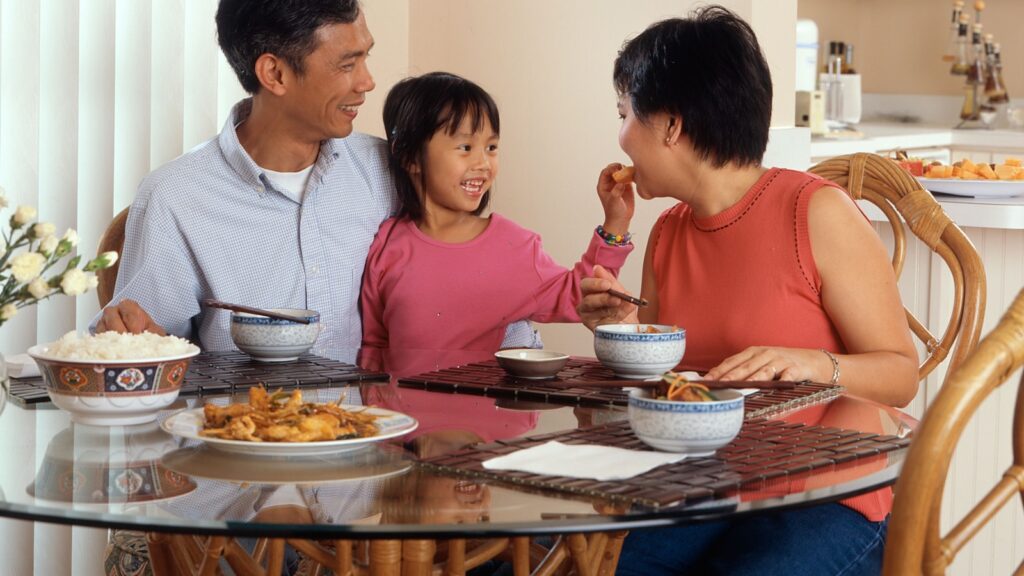
The active ingredient is the talking, not the table. Photo: Vitaly Gariev / Unsplash.
So what is the active ingredient?
Language, mostly — and a specific kind of it.
Harvard researcher Catherine Snow spent years on the Home-School Study of Language and Literacy, tracking low-income children from preschool into adolescence. One of the study’s most repeated findings was that the vocabulary children picked up at the dinner table predicted later literacy at least as well as being read to did. What mattered was exposure to what researchers call decontextualized language: talk about things that are not physically present. Stories about your day. Explanations. Speculation about the future. Arguments about whether a movie was any good.
That is a very different instruction than “eat together.” A silent dinner with the TV on delivers none of it. A twenty-minute drive home from practice where a parent asks real questions delivers a lot of it.
Why does the meal still help, even if it is not magic?
Because it is a container, and containers are underrated.
A meal creates a block of time with three properties that are otherwise hard to arrange: everyone is in one place, nobody has a competing task, and it repeats without needing to be scheduled. Adolescents in particular tend to disclose sideways rather than on demand — the useful thing gets mentioned in the middle of something else, twelve minutes in, not in response to “how was your day.” A recurring low-stakes block is what makes that twelve-minute mark reachable at all.
This is also why phones do so much damage here, and why the effect is not limited to teenagers. Research on parental device use during family time — sometimes called technoference — finds that even brief interruptions disrupt the back-and-forth that makes conversation productive. We have written more on that pattern in technoference and kids. Removing phones from a mediocre family dinner does more for it than adding two more dinners a week.
What should a parent do with this instead?
Stop optimizing for frequency and start optimizing for quality of talk. Concretely:
Protect any recurring twenty-minute block, not specifically dinner. Breakfast counts. The drive counts. The last twenty minutes before bed counts. What matters is that it recurs and that nobody is doing anything else. A family that eats together twice a week and talks well beats a family that eats together six times in silence.
Ask questions that cannot be answered in one word. “What was the most annoying part of today” outperforms “how was school” every time, because it gives permission for a real answer. So does asking your child’s opinion about something adult — a news story, a decision you are weighing, a disagreement you had at work.
Talk about things that are not in the room. The decontextualized-language finding is directly actionable. Tell stories about your own childhood. Explain how something works. Speculate. This is where the vocabulary lives.
Let the boring parts run. Adults tend to close conversations efficiently. Kids need the dead air. Some of the most important disclosures arrive after a lull that a parent was tempted to fill.
Do not use the block for correction. If the recurring twenty minutes becomes the reliable venue for grades, chores, and behavior reviews, children will stop showing up psychologically even while sitting there. Feedback has its own time — and the way it is delivered matters as much as the content, which is why how we praise kids turns out to be surprisingly consequential.

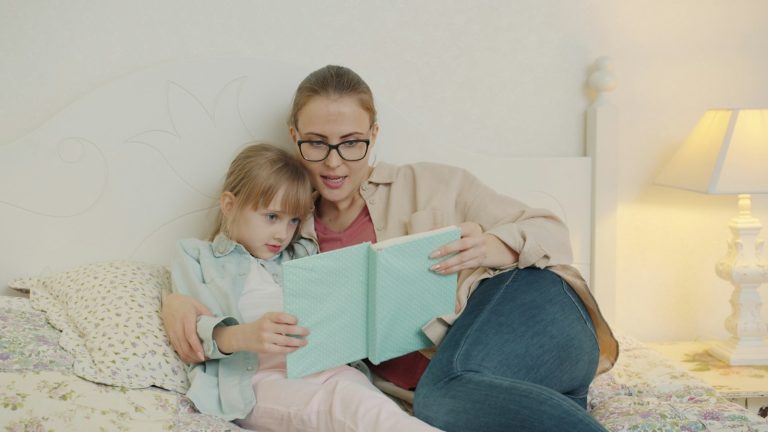
Twice a week with real conversation beats six nights of silence. Photo: Tyson / Unsplash.
Who does this reframe help most?
Shift workers. Single parents. Families with two jobs and a commute. Parents of teenagers whose schedules have already fragmented beyond repair.
The family-dinner narrative has functioned, for a lot of these households, as a low-grade source of guilt about a structural problem they cannot solve. A nurse working nights is not going to produce five family dinners a week, and the research does not say she needs to. She needs a repeating window where her kids talk to her without a screen between them. That window can be at 6 a.m. It can be on Sunday. It can be in the car.
The instruction “eat dinner together” was always a proxy. Proxies are useful right up until people start chasing the proxy instead of the thing.
Frequently asked questions about family dinners
How many family dinners per week do we actually need?
There is no evidence-based threshold, and the number frequently quoted in media coverage does not come from a causal study. Consistency matters more than count: one predictable, phone-free block that everyone can count on is worth more than an ambitious schedule that collapses after two weeks.
Do family dinners really prevent teen substance use?
The correlation is real but the causal evidence is weak. When Musick and Meier controlled for the broader family environment, the associations with substance use and delinquency largely disappeared. Families that eat together frequently also tend to have more supervision, more time, and more resources — and those factors appear to carry most of the weight.
What if our dinners turn into arguments?
A tense dinner is not automatically a failed one; conflict handled and then repaired teaches children something a conflict-free table cannot. The problem is unrepaired conflict, which is a different thing entirely. If arguments are the norm rather than the exception, it is usually worth changing the topic mix before changing the schedule.
Does it count if we eat in front of the TV?
For the nutritional and logistical benefits, yes. For the conversational ones, mostly no — a screen absorbs exactly the attention that makes the back-and-forth work. If the TV is the only way the meal happens on a given night, that is fine; just do not count it as the twenty minutes.
The takeaway worth keeping
Family dinners are a good habit sitting on top of a better one. The meal is the scaffolding; the conversation is the building. If your family can manage both, excellent. If your life only permits one, keep the conversation and let go of the guilt about the table — the evidence is on your side.
For more evidence-based takes on raising kids, browse our Family Life & Parenting archive.
Written by
Elena Rostova
Elena Rostova is the byline used for articles published by Relationship 99. It is a pen name, not a licensed clinician. Articles here are built from published research in relationship science - including work by John Gottman, Arthur Aron and researchers in attachment theory - with the studies named in the text so readers can check them. How we research, source and review our articles is set out in full at relationship-99.com/editorial-standards. Relationship 99 is not a therapy service, and nothing here replaces advice from a qualified professional.