Almost every engaged couple is told some version of the same thing: don’t let wedding planning stress on relationships get to you, it’s just one day, the marriage is what matters. It is kind advice and it is mostly wrong. Wedding planning is not a distraction from your marriage. It is the first live run of the three systems your marriage will actually operate on, and it is running them under deadline, in public, with your families watching.
The useful reframe: a wedding is a nine-month simulation of joint money decisions, family boundary-setting, and decision-making under time pressure. The stress is not noise obscuring the signal. In most cases the stress is the signal — and it is the cheapest diagnostic information you will ever get about how the two of you handle hard things together.

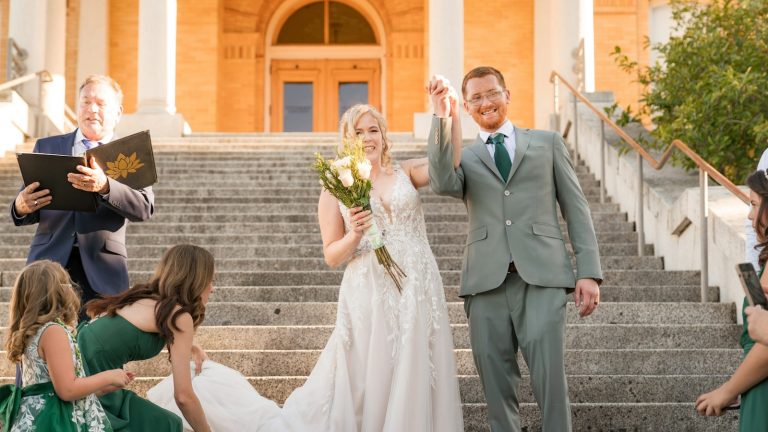
The planning year is a rehearsal for the systems you will run for decades. Photo: Harli Marten / Unsplash.
What does wedding planning actually reveal?
Three things, and they map almost exactly onto the domains that predict long-run marital strain.
How you make joint financial decisions. A wedding is likely the largest discretionary purchase you have ever made together, and it is made in dozens of increments over months. You will discover, involuntarily, whose sense of “reasonable” governs, whether one of you defers and then resents, and what each of you believes money is for.
Where your family boundaries sit. Guest lists, contributions, seating, religious elements, and the question of whose traditions get honored are all boundary questions wearing logistics costumes. You will find out whether your partner can say no to their own parents, and whether you can.
How you decide under pressure. Hundreds of decisions, a hard deadline, incomplete information, and real money. This is exactly the cognitive environment of a house purchase, a medical crisis, or a relocation — the situations where couples find out what they are like.
Sonya Britt-Lutter’s research at Kansas State, using longitudinal data from more than 4,500 couples, found that arguments about money early in a relationship predicted divorce better than arguments about children, sex, or in-laws — and the finding held regardless of income or net worth. If you are going to have your first serious money arguments somewhere, having them while planning a wedding is not a disaster. It is arguably good timing.
Which conflicts are diagnostic, and which are just noise?
Not every wedding fight means something. The distinction is worth learning, because couples routinely panic over the meaningless ones and wave through the significant ones.
Noise: fights about the object
Arguments about flowers, playlists, colors, and font choices are almost always fatigue in disguise. They are frequent, loud, and forgettable. If a fight resolves once someone eats something, it was noise.
Signal: fights about who decides
Arguments about whose preference wins by default, who gets consulted, and who has to justify themselves are structural. These do not resolve with a snack. They recur with new content every few weeks, and they will keep recurring for thirty years with the content swapped for schools, houses, and elder care.
Signal: fights where a third party is really the opponent
If a disagreement between the two of you is actually a disagreement between one of you and a parent — with your partner acting as the parent’s proxy — that is the most important information the planning year will give you. It is the boundary question, and it does not go away after the wedding. It reappears at the first holiday and every one after.

The question is not whose family wins. It is whether the two of you answer as one unit. Photo: Priscilla Du Preez / Unsplash.
The one rule that prevents most of the damage
Each of you handles your own family. Always, without exception, even when it is inefficient.
This sounds like a division of labor. It is actually a boundary architecture, and it is the single most protective habit an engaged couple can build. When you deliver a difficult decision to your own parents, the conversation stays inside a relationship with forty years of accumulated goodwill and a well-worn repair process. When your partner delivers it, it becomes a first impression that never fully fades — and the family stores the resentment under your partner’s name rather than yours.
The corollary is harder: you have to actually deliver the message, including when you privately agree with your mother. The couple decides together in private, and then each person represents that decision to their own side as their own position. Any crack in that — “well, I wanted you there, but she said no” — teaches both families exactly where to apply pressure for the next thirty years.
What money conversations to have before the deposits
Before you book anything, three conversations, in this order, ideally away from a spreadsheet.
First: what is this wedding for? A party for your friends, an obligation to your parents, a religious rite, a public commitment? Couples who skip this argue about budget forever, because they are optimizing for different events.
Second: what is the total number, and where is it coming from? Not per-category — the ceiling. Include the honeymoon and the rings. Say the number out loud.
Third, and most neglected: what does accepting family money buy them? If a parent contributes, decide in advance and explicitly whether that contribution comes with influence over the guest list or the venue. Undiscussed contributions turn into implied vetoes about four months in, and by then the money is spent.
When to take the stress seriously
One honest caveat. Everything above assumes ordinary conflict between two people who fundamentally want to marry each other. Sometimes the planning year surfaces something else.
If the disagreements consistently involve contempt — eye-rolling, mockery, name-calling — that is a different category, and it is the strongest single behavioral predictor of divorce in Gottman’s research. If one partner is disengaged from every decision and then critical of the outcome, or if you find yourself concealing decisions to avoid a reaction, the wedding is not the problem. If the doubt is persistent, quiet, and about the person rather than the event, that is worth taking seriously rather than planning through; see our piece on cold feet before the wedding.
Frequently asked questions
Is it normal to fight a lot while wedding planning?
Yes. You are making an unusual number of consequential joint decisions in a compressed window while managing two families’ expectations, and most couples have never done anything comparable. Frequency is normal. What matters is whether conflicts resolve, whether both people feel heard, and whether the same structural disagreement keeps reappearing in new costumes.
Should we do premarital counseling?
It’s worth considering, and the planning year is a good time precisely because real disagreements are already on the table rather than hypothetical. Structured premarital programs are generally associated with modest improvements in early marital satisfaction. Going in with live material tends to be more useful than going in calm.
How do we handle parents who are paying and pushing?
Decide together, in advance, what the contribution entitles them to, and say it out loud to them — ideally before accepting. If that conversation feels impossible, that is information about whether the money is worth taking. Each of you then holds that line with your own parents.
Does an expensive wedding predict a worse marriage?
A widely cited 2014 Emory University study by Andrew Francis-Regan and Hugo Mialon found higher wedding spending associated with shorter marriages, but it was correlational and has been debated since. The safer reading is that debt and financial strain are the meaningful risk factors, not the price of the flowers.
The takeaway worth keeping
Stop trying to get through the planning year unscathed. Treat it as the first project the two of you have ever run together, and pay attention to how you run it — who defers, who decides, who holds the boundary, and how you recover when it goes badly. Those patterns are not going to change on the wedding day. Knowing them now is the actual point.
More in our Dating & Engaged archive and our Marriage archive.
Written by
Elena Rostova
Elena Rostova is the byline used for articles published by Relationship 99. It is a pen name, not a licensed clinician. Articles here are built from published research in relationship science - including work by John Gottman, Arthur Aron and researchers in attachment theory - with the studies named in the text so readers can check them. How we research, source and review our articles is set out in full at relationship-99.com/editorial-standards. Relationship 99 is not a therapy service, and nothing here replaces advice from a qualified professional.