What is slow dating, and why is it catching on?
Slow dating is the practice of dating one person at a time with intention: fewer matches, longer conversations, and a deliberate willingness to let attraction develop before deciding whether to move on. Instead of maximizing options, you concentrate your attention. It has caught on because the swipe-everything model quietly exhausted a lot of people, and slow dating offers a way to date that feels human again rather than like managing an inbox.
The appeal is not nostalgia. It is a response to a measurable problem. Pew Research Center surveys on online dating have found that a large share of users describe the experience as more frustrating than exciting, and many report feeling burned out by the sheer volume of it. Slow dating treats that fatigue as information: if the endless-options approach leaves you emptier, the answer may be fewer options, held more attentively.

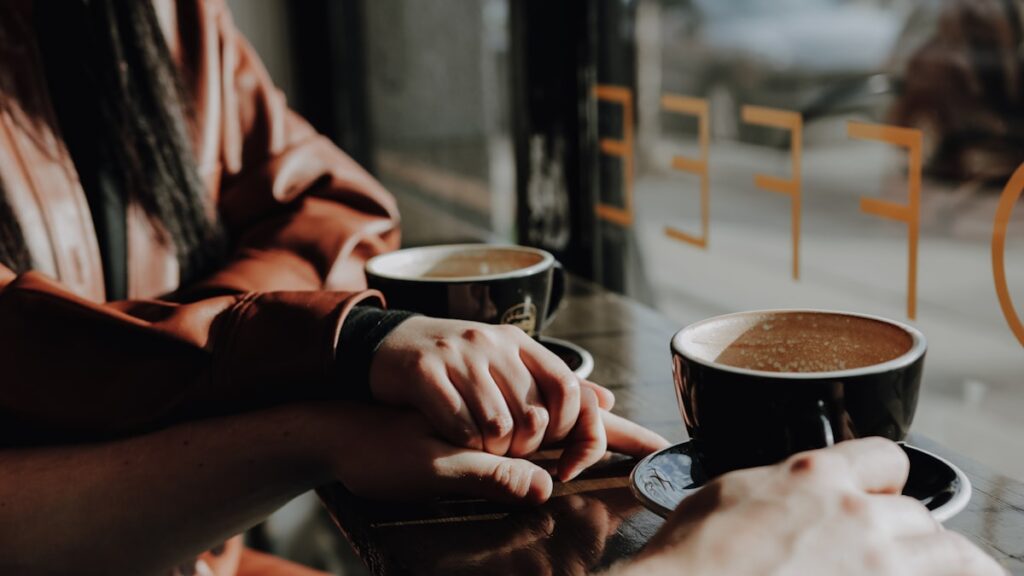
One conversation, given room to breathe. Photo: Unsplash.
Why does swiping culture leave so many people drained?
Part of the answer is choice overload. Psychologist Barry Schwartz popularized the paradox of choice, and Sheena Iyengar’s famous jam-tasting study showed that when people face too many options, they are less likely to choose at all and less satisfied when they do. Dating apps present an almost infinite shelf. The mind responds by treating potential partners as interchangeable, always wondering whether the next profile is marginally better. That mindset is corrosive to the very thing dating is supposed to build.
There is also the emotional whiplash of low-commitment behaviors that thrive in high-volume dating. When everyone has a queue, it is easy to keep several people on a slow simmer, which is how patterns like breadcrumbing and orbiting become normal. Slow dating pushes against all of this by asking a simple question: what if you gave one connection your genuine attention before auditioning the next?
Is slow dating the same as being exclusive?
Not exactly. Exclusivity is a commitment you agree to with another person. Slow dating is a posture you bring to the process, whether or not you have had the exclusivity talk. You can slow-date while still technically single, simply by refusing to divide your focus across a roster and by letting each connection develop at a real pace. The distinction matters, because slow dating is about the quality of your attention, not a label on the relationship.
How do you actually date slowly without losing momentum?
The fear people raise is that slowing down means stalling. In practice, slow dating tends to create momentum, because depth is what makes a second and third date feel worth it. Here is what it looks like in ordinary terms.
Narrow the funnel on purpose
Rather than matching with everyone and sorting later, be selective at the top. Fewer, more considered matches mean each conversation gets real energy instead of a distracted, copy-pasted opener. You are not trying to keep options warm; you are trying to find out whether this one person is someone you want to keep seeing.
Move to a real conversation early, then let it breathe
Endless texting is its own trap. Slow dating does not mean dragging out the chat for weeks; it means moving to a genuine, in-person or voice conversation before the spark dies in the app, and then not rushing to define everything by date two. Give attraction the time it needs to become something more than novelty. Our piece on the ick is a useful companion here, because slowing down helps you tell a real dealbreaker from a fleeting, anxious reaction.

Depth is the thing that actually keeps momentum going. Photo: Unsplash.
Resist the optimizer’s itch
The hardest part is psychological. Slow dating asks you to stop treating every date as a comparison against a hypothetical better match. Anthropologist Helen Fisher, who has studied the biology of attraction through the long-running Singles in America research, has noted that taking time to know someone gives the slower systems of attachment a chance to engage. Instant certainty is rare; earned certainty is common. If the numbers game tempts you, our explainer on the 37 percent rule is a fun reminder that even optimal-stopping math eventually tells you to commit rather than keep sampling.
Who is slow dating best for?
Slow dating tends to suit people who feel jaded by apps, who notice they self-sabotage the moment things get real, or who want a relationship rather than a rotation. It is less about willpower and more about relief: many people find that concentrating on one connection lowers the anxiety that high-volume dating manufactures. If you have been dating for a while and feel more numb than hopeful, that numbness is often a sign the volume, not your capacity for connection, is the problem. You can explore more of these dynamics across our dating and engaged guides.
Frequently asked questions
Does slow dating mean I can only talk to one person at a time?
Not necessarily. Slow dating is about attention, not a strict rule. Some people focus on a single connection; others keep things light with one or two while still refusing to speed-run intimacy. The core idea is to stop treating dating as volume and start treating it as depth.
Will slow dating make me miss out on better matches?
The research on choice overload suggests the opposite risk: endless options tend to lower satisfaction and make commitment harder, not easier. Slow dating trades the illusion of unlimited better matches for the reality of actually getting to know someone.
How long should slow dating take before defining the relationship?
There is no fixed timeline. The point is to let genuine attachment form rather than forcing a label on date two or bailing the instant novelty fades. Many people find that a few unhurried dates make the exclusivity conversation feel natural rather than premature.
Can slow dating work if I use dating apps?
Yes. Slow dating is a mindset you bring to any channel. On apps it usually means matching more selectively, moving to a real conversation sooner, and resisting the urge to keep a large queue warm while you decide.
Written by
Elena Rostova
Elena Rostova is the byline used for articles published by Relationship 99. It is a pen name, not a licensed clinician. Articles here are built from published research in relationship science - including work by John Gottman, Arthur Aron and researchers in attachment theory - with the studies named in the text so readers can check them. How we research, source and review our articles is set out in full at relationship-99.com/editorial-standards. Relationship 99 is not a therapy service, and nothing here replaces advice from a qualified professional.