Kids lying is a normal developmental milestone, not a sign of bad character. Most children start telling simple lies between ages two and four, as their thinking skills mature. The counter-intuitive finding is that harsh punishment makes children lie more and lie better. What builds honesty is making the truth safe to tell, and praising it when it happens.
Key Takeaways
- Early lies track brain development: in one lab study of 65 two- and three-year-olds, stronger executive functioning predicted lying regardless of age.
- In a natural experiment, 94% of children at a punitive school lied about a small rule-break, compared with 55% at a non-punitive school (Talwar & Lee, 2011).
- Telling kids the truth will please you, and praising honesty, works better than threats; stories about rewarded honesty beat stories about punished lies.
It usually starts with something tiny. A four-year-old with chocolate on her face says she did not eat the cookie. A seven-year-old swears his homework is done while the worksheet sits blank in his backpack. Parents feel a jolt of alarm: if they lie about this, what will they lie about at fifteen?
That fear is understandable, and it is also where many well-meaning responses go wrong. Developmental psychologists have studied kids lying for decades, often with a simple lab setup, and the results point toward a calmer, more effective approach than most of us were raised with.
Why Kids Lying Is Part of Normal Development
Lying is saying something you know is false so that someone else will believe it, and to do it a child has to manage several hard things at once. They must understand that you do not know what they know, hold the truth in mind while saying something else, and suppress the urge to blurt out what really happened. Theory of mind is the understanding that other people have different knowledge and beliefs. Executive functioning is the set of skills, such as working memory and impulse control, that lets a child hold one thing in mind while doing another.
Researchers Angela Evans and Kang Lee tested this with 65 children aged two and three. Each child was told not to peek at a toy while alone in the room. About 80% of the children peeked, and older children were more likely to deny it (Evans & Lee, 2013). Executive functioning skills predicted lying even after accounting for age. The researchers’ point was that early lying is a sign of developing cognition, not a moral failing.
That does not mean lies should be ignored. It means early episodes of kids lying are an opening to teach, not evidence that something is wrong with your child. Motives also shift with age: avoiding trouble for toddlers, protecting privacy or status for school-age kids, and autonomy for teens.
Kids Lying at Each Age: What to Expect
| Age | Typical lies | Most helpful response |
|---|---|---|
| 2–4 | Simple denials (“I didn’t”), often obvious | State what you saw, skip the trap question, focus on fixing it |
| 5–8 | Lies to avoid trouble or protect feelings; more consistent stories | Make honesty easy, praise truth-telling, use stories about honesty |
| 9–12 | Lies about homework, screens, friends; testing privacy | Separate the lie from the rule-break, problem-solve together |
| 13+ | Lies to gain autonomy or avoid conflict | Negotiate fair rules; trust grows with track record |
Why Punishment Makes Kids Lying Worse
The most striking evidence on kids lying comes from a natural experiment in West Africa. Victoria Talwar and Kang Lee compared two schools in the same neighborhood. One used harsh, frequent physical punishment; the other used time-outs and reprimands. In the same peeking test, 94% of children at the punitive school lied, versus 55% at the other school. Children from the punitive school were also much better at keeping their lies consistent.
The study was small, and children were not randomly assigned to schools, so it is not the final word. But the direction fits a broader pattern in research on kids lying. When the cost of the truth is high, children put their growing brains to work on getting better at hiding it.
A larger lab study reinforces this. With 372 children aged four to eight, Talwar’s team found that roughly two-thirds of the children who peeked lied about it. Children were less likely to tell the truth when they feared punishment than when they were told honesty would please the adult or was the right thing to do. Older children responded especially well to the idea that telling the truth would make the adult happy.

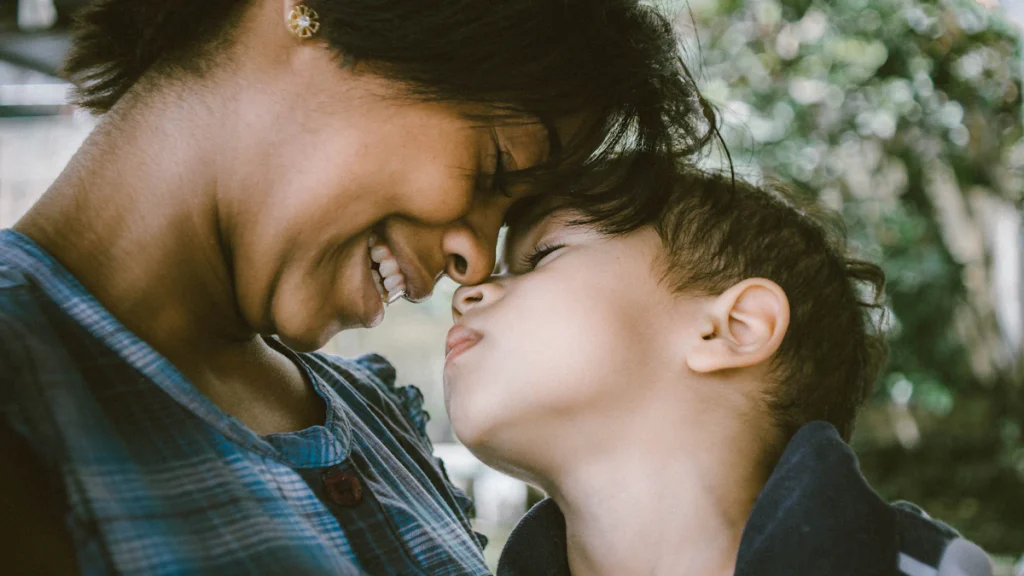
Getting down to a child’s level lowers the stakes of telling the truth. Photo: Jonathan Borba / Unsplash.
How to Respond to Kids Lying in the Moment
The moment you catch kids lying is a moment of high emotion for both of you. A simple sequence keeps it from becoming a power struggle:
- Don’t set a trap. If you saw your son hit his sister, asking “Did you hit her?” invites a lie. Say what you know: “I saw you hit your sister.”
- Lower the temperature. Take a breath. Children lie more when they expect an explosion, and they read your face long before your words.
- Invite the truth directly. “I’ll be really glad if you tell me what happened. You won’t be in extra trouble for telling the truth.”
- Separate the two problems. Deal with the original misbehavior with a fair, predictable consequence. Treat the lie as a conversation, not a second punishment. Logical, natural consequences work better here than piling on.
- Repair the relationship. End with connection. A brief “Thank you for telling me” goes further than a lecture. The principles of rupture and repair in parenting apply here.
Language matters too. Describing what you notice (“The paint is on the wall, and you’re holding the brush”) rather than interrogating can reduce defensiveness. This approach is the core of declarative language parenting.
Preventing Kids Lying by Building Honesty Over Time
The moment-to-moment response matters, but the bigger influence is the climate at home. Three research-backed habits help.
Praise honesty specifically. In a study of 268 children aged three to seven, hearing the story of young George Washington confessing to chopping the cherry tree, and being praised for it, made children about three times more likely to tell the truth. Stories about the punishments of lying, like “Pinocchio” and “The Boy Who Cried Wolf,” did no better than a story unrelated to honesty.
Model it yourself. Parents often tell small lies to manage behavior: “The playground is closed today” or “If you don’t come now, I’ll leave you here.” A survey of 379 young adults in Singapore found that people who recalled more of this kind of “parenting by lying” reported lying to their parents more as adults, along with more adjustment difficulties. It was a retrospective, correlational study, but the takeaway is easy to act on: tell children the real reason.
Name feelings, not just facts. Many lies come from fear, shame, or wanting to please. When you help a child put words to the feeling (“You were worried I’d be upset about the vase”), you reduce the pressure that produced the lie. That is the heart of emotion coaching.

Many lies come from fear or shame rather than defiance. Photo: Idzard Schiphof / Unsplash.
When Kids Lying Is a Bigger Concern
Most kids lying is ordinary. A few patterns are worth a closer look with your pediatrician or a child psychologist:
- Frequent, elaborate lies that continue past age eight even in a calm, low-punishment home.
- Lying alongside other serious behaviors such as stealing, cruelty to animals or people, or repeated rule-breaking at school.
- Lies that seem designed to hide something happening to the child, such as bullying, or contact with an adult who asked them to keep a secret.
That last point is important. Teach the difference between a surprise (something fun that will be revealed soon) and a secret that makes a child feel uncomfortable. Children should know they can always tell you, and never get in trouble for it.
Frequently Asked Questions About Kids Lying
At what age do kids start lying?
Many children tell their first simple lies between ages two and three, and most children lie at least occasionally by age four. Early lying reflects growing thinking skills rather than a moral problem.
Should I punish my child for lying?
Address the original misbehavior with a fair, predictable consequence, but avoid adding harsh punishment for the lie itself. Research shows fear of punishment makes children less likely to tell the truth, and better at hiding it.
Is kids lying about homework or screens normal?
Yes, especially between ages eight and twelve. These lies usually signal a rule that feels unfair or a task that feels overwhelming. Problem-solving the underlying issue works better than tighter surveillance.
How do I get my child to admit the truth?
Tell them what you already know, promise that telling the truth will not add extra trouble, and keep that promise. Then thank them when they are honest, even if the news is unwelcome.
Raising a Child Who Tells You the Truth
The goal is not to stop kids lying entirely. Every child will lie sometimes. The goal is a child who learns, over years of small moments, that the truth is safe to bring to you. That means fewer traps, calmer reactions, clear and fair consequences, and specific praise for honesty.
When your teenager eventually tells you about something hard, it will be because a hundred earlier confessions went better than they feared. That is a long game, and every cookie and every blank worksheet is a chance to play it well.
This article is for general information and is not a substitute for professional advice. If you are concerned about your child’s behavior or safety, talk with your pediatrician. If anyone in your home is being harmed, contact the National Domestic Violence Hotline at 1-800-799-7233.
About this article: written by Elena Rostova, the site’s disclosed pen name, under our editorial standards. How we work: we read the primary studies linked above and report their sample sizes and limits rather than headlines. Spotted an error or outdated figure? Contact us, or read more about us.
Written by
Elena Rostova
Elena Rostova is the byline used for articles published by Relationship 99. It is a pen name, not a licensed clinician. Articles here are built from published research in relationship science - including work by John Gottman, Arthur Aron and researchers in attachment theory - with the studies named in the text so readers can check them. How we research, source and review our articles is set out in full at relationship-99.com/editorial-standards. Relationship 99 is not a therapy service, and nothing here replaces advice from a qualified professional.