Enmeshment in marriage is a pattern in which two spouses become so emotionally fused that one partner’s moods, opinions, and needs get treated as the couple’s whole reality, leaving little room for a separate self. It is not the same as closeness. The repair is not more distance but greater differentiation: staying warmly connected while still owning your own thoughts, feelings, and decisions.
Key Takeaways
- Enmeshment is fusion, not intimacy: real closeness lets two selves stay whole, while fusion collapses them into one anxious unit.
- The antidote to enmeshment in marriage is differentiation of self — Murray Bowen’s term for holding onto who you are while staying emotionally close to your partner.
- In a longitudinal study of Spanish and U.S. couples, higher differentiation of self predicted better relationship quality and greater stability over time.
You can usually spot it in the small moments. Your partner comes home in a bad mood, and within minutes your own good day has evaporated. You cannot name a preference — a restaurant, a weekend plan, a film — without first scanning their face. Somewhere along the way, “us” quietly swallowed “I,” and it felt like devotion. That slow disappearance of a separate self is the heart of enmeshment in marriage, and it is far more common than most couples realize.
What enmeshment in marriage actually means
The concept comes from two overlapping traditions. Family therapist Salvador Minuchin used “enmeshment” to describe families with blurry boundaries, where members are over-involved in one another’s feelings. Psychiatrist Murray Bowen framed the same problem as low differentiation of self: the degree to which you can stay emotionally connected to someone without losing your own center. Bowen placed differentiation on a continuum, from complete fusion at one end to solid autonomy at the other.
Enmeshment in marriage sits near the fusion end. When one partner is anxious, both are anxious. When one disapproves, the other cannot rest. Agreement becomes the price of peace, so disagreement starts to feel dangerous. The couple mistakes this reactivity for intimacy, but true intimacy needs two distinct people who choose each other — not one merged unit that cannot tell where one ends and the other begins.
How common is enmeshment in marriage, and where does it begin?
Enmeshment in marriage rarely starts in the marriage itself. Bowen believed we tend to marry at roughly our own level of differentiation, carrying the emotional habits learned in our families of origin straight into our partnerships. Someone raised in a home where love meant constant agreement, shared moods, and no privacy often recreates that blueprint as an adult — because it is the only version of closeness their nervous system recognizes.
That is why enmeshment in marriage can feel both suffocating and completely normal at the same time. It is not a character flaw or a sign that you chose the wrong person. It is a learned relational style, and like any learned style, it can be reshaped with awareness and practice.
Enmeshment vs. healthy interdependence vs. emotional cutoff
Fusion is not the only way boundaries go wrong. Its mirror image is emotional cutoff — managing closeness by going cold, distant, or numb. Healthy interdependence sits between them. The table below maps how each pattern handles the everyday tensions of a marriage.
| Situation | Enmeshment (fusion) | Healthy interdependence | Emotional cutoff |
|---|---|---|---|
| Partner is upset | I cannot be okay until they are okay | I care and stay steady while they feel it | I withdraw and tune them out |
| You disagree | Conflict feels like a threat to the bond | Two views can coexist | Why bother — I stop sharing |
| Time apart | Guilt, anxiety, or resentment | Space that refuels the relationship | Relief that masks distance |
| Your own opinion | Borrowed from my partner | Mine, and I can voice it kindly | Kept hidden to avoid friction |
The signs of enmeshment in marriage
Enmeshment rarely announces itself. It shows up as habits that look caring from the outside. You may notice that you cannot make a decision without checking in first, or that your partner’s disapproval ruins your entire day. Perhaps you have stopped seeing friends because it upsets them, or you feel responsible for managing their emotions so the household stays calm.
Other signs are quieter: finishing each other’s sentences to the point that you no longer know your own, feeling anxious guilt whenever you want something different, or describing your whole identity in the language of “we.” None of these make you a bad partner. They are simply a nervous system that has learned to treat separateness as danger — and that pattern can be unlearned.

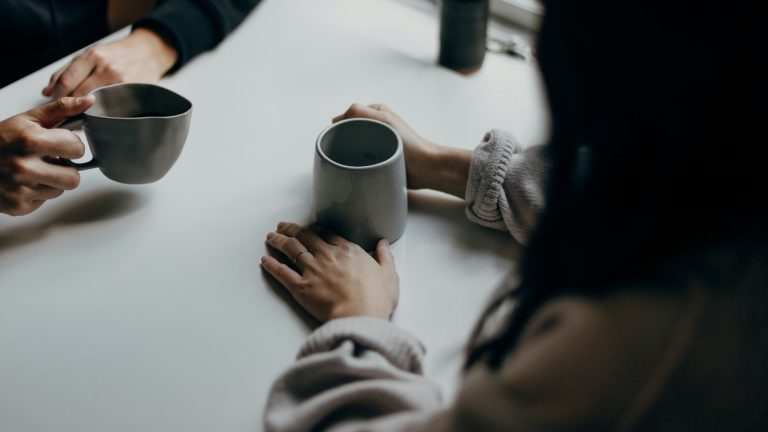
Fusion can feel like devotion while it quietly erases two separate selves. Photo: bhuvanesh gupta / Unsplash.
Why fusion feels like love but quietly erodes it
Early on, merging is intoxicating. Sharing every thought and needing nothing but each other reads as proof of a great love. The paradox of enmeshment in marriage is that this fusion runs on anxiety, not choice. If your calm depends on your partner’s approval, then their bad mood becomes your emergency, and you will start to shape yourself around keeping them content.
Over time this breeds two predictable outcomes. One partner over-functions — managing, fixing, anticipating — while the other under-functions and slowly disappears. Resentment collects on both sides. Desire often fades too, because longing needs a little distance to exist, and there is no space left to cross. Many couples who describe feeling married but lonely are living inside exactly this kind of fused, self-erasing closeness.
What the research on differentiation of self shows
The good news is that the opposite of enmeshment in marriage is measurable and learnable. Decades of research on Bowen’s differentiation of self point the same direction, though most of these studies are correlational and cannot prove cause on their own.
In a longitudinal, dyadic path analysis of Spanish and U.S. couples, higher differentiation of self predicted stronger relationship quality and greater stability across time (PLOS ONE, 2023). A separate study of parents found that emotional cutoff and fusion each accounted for meaningful variance in a couple’s warmth and communication, with roughly 7–10% of the variance tied to those two patterns alone (PLOS ONE, 2022). Notably, lower emotional cutoff was linked to higher romantic satisfaction — distance is no safer than fusion.
Differentiation also protects couples from each other’s stress. In an actor–partner analysis, one spouse’s emotional cutoff predicted the other spouse’s dyadic adjustment, showing how one person’s fusion or flight ripples across the marriage (Contemporary Family Therapy, 2019). Fear of intimacy appears to be one mechanism: in a dyadic model it statistically mediated the link between low differentiation and lower marital satisfaction. Even modern habits track it — lower differentiation predicts more “phubbing,” or snubbing a partner for a phone (Scientific Reports, 2024).

Differentiation means staying connected without losing your own footing. Photo: Duong Huu / Unsplash.
How to move from enmeshment in marriage to connected autonomy
Untangling enmeshment in marriage is not about loving less. It is about becoming a fuller, steadier person your partner can actually meet. Start by noticing your reactivity: when their mood shifts, pause before you absorb it, and silently name “that is their feeling, and I can stay grounded.” This single beat of separation is the beginning of differentiation.
Then practice having a self in the room. State a preference without a disclaimer. Keep one friendship, hobby, or routine that is entirely yours. Tolerate the discomfort of a disagreement without rushing to smooth it over. When you stop over-functioning, your partner has room to step up; when you stop under-functioning, you reappear. If old resentment has already hardened, working through resentment in marriage and understanding your anxious or avoidant patterns can make the shift far less threatening. A couples or family therapist trained in Bowen or emotionally focused therapy can help you do this without either partner feeling abandoned.
Frequently asked questions about enmeshment in marriage
Is enmeshment in marriage the same as codependency? They overlap heavily. Codependency usually describes one partner organizing their life around another’s needs or addiction, while enmeshment in marriage is the broader boundary problem of fused identities. Both improve as you strengthen differentiation of self.
Can a close, happy couple still have enmeshment in marriage? Closeness alone is not the warning sign. The tell is whether you can disagree, spend time apart, and hold your own opinions without anxiety. If separateness feels unsafe, the closeness may be fusion rather than intimacy.
Does fixing enmeshment mean growing apart? No — it usually brings couples closer. Differentiation replaces anxious merging with genuine choice, so partners connect because they want to, not because they are afraid to be separate.
How long does it take to change? Because these patterns are wired into the nervous system, change is gradual and non-linear. Small, repeated acts of staying grounded during conflict tend to matter more than any single breakthrough.
This article is for general education and is not a substitute for professional care. Enmeshment can sometimes overlap with controlling or coercive dynamics; if you ever feel unsafe, afraid, or unable to make your own choices, support is available through the National Domestic Violence Hotline at 1-800-799-7233.
Written by
Elena Rostova
Elena Rostova is the byline used for articles published by Relationship 99. It is a pen name, not a licensed clinician. Articles here are built from published research in relationship science - including work by John Gottman, Arthur Aron and researchers in attachment theory - with the studies named in the text so readers can check them. How we research, source and review our articles is set out in full at relationship-99.com/editorial-standards. Relationship 99 is not a therapy service, and nothing here replaces advice from a qualified professional.